


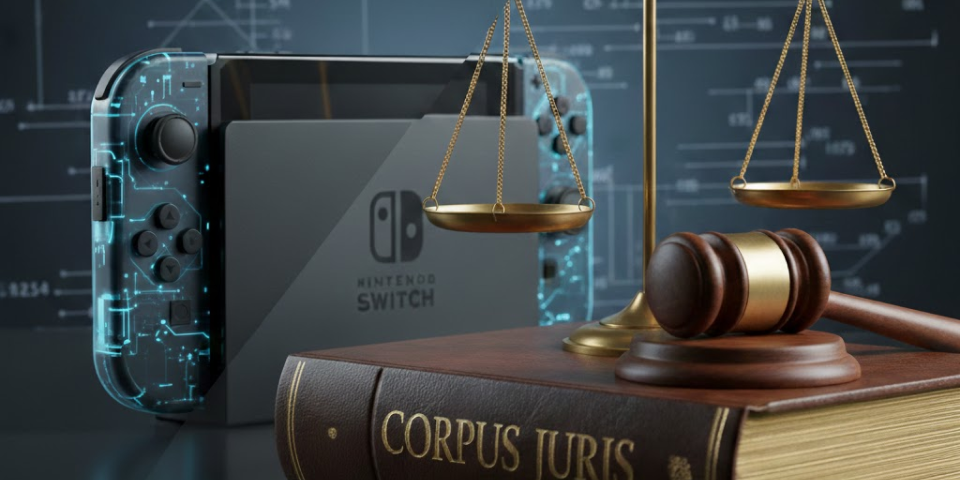
The intellectual property landscape in the gaming industry is witnessing a significant new development: at the end of 2025, the Director of the United States Patent and Trademark Office (USPTO) ordered the initiation of a re-examination procedure for U.S. Patent No. 12,403,397 B2, held by Nintendo.
This administrative procedure provides for the USPTO to conduct a rigorous analysis of the validity of an already granted patent title should well-founded doubts regarding its requirements arise. It is crucial to specify that, at present, the patent has not been canceled or revoked and remains in full force. However, the commencement of the review introduces an element of uncertainty regarding its future enforceability and legal status.
Grounds for Review: The “Substantial New Question of Patentability”
The investigation, initiated ex officio by the USPTO on November 3, 2025, is structured as an ex parte re-examination. The decision to proceed with a new evaluation of the patent’s primary claims stems from the identification of a “substantial new question of patentability.”
The re-examination focuses specifically on two documented pieces of prior art that could impact the title’s originality:
- A disclosure attributed to Konami dating back to 2002.
- A previous publication by Nintendo itself dated 2019.
These documents will be analyzed to verify whether the claimed mechanics still satisfy the requirements of novelty and non-obviousness, which are necessary to prevent the invention from appearing “obvious” to a person having ordinary skill in the art (PHOSITA).
Technical Analysis: Game Mechanics and State of the Art
The subject of the dispute concerns a specific gameplay mechanic: the summoning of a subsidiary character capable of acting both autonomously and under the user’s control.
While the initial grant had already sparked debate among Intellectual Property (IP) experts, many observers noted that similar dynamics—such as companion AI, automated combat, and contextual commands—have been present for decades in iconic titles like Elden Ring, Persona, or Diablo. The re-examination procedure will determine whether Nintendo’s claims represent an effective innovation or a reformulation of concepts already belonging to the state of the art.
Current Status and Validity of the Title
Pending the conclusion of the administrative proceedings, Patent ‘397 remains duly registered, and the rights associated with it are fully enforceable. No official revocations or amendments to its scope have occurred.
The case continues to be monitored with extreme attention by developers and IP rights holders in the video game sector, as the final outcome could lead to a limitation or partial invalidation of the current claims.
Article in collaboration with AW LEGAL
AW LEGAL is a law firm specializing in Intellectual Property, Privacy, and Legal Tech.