

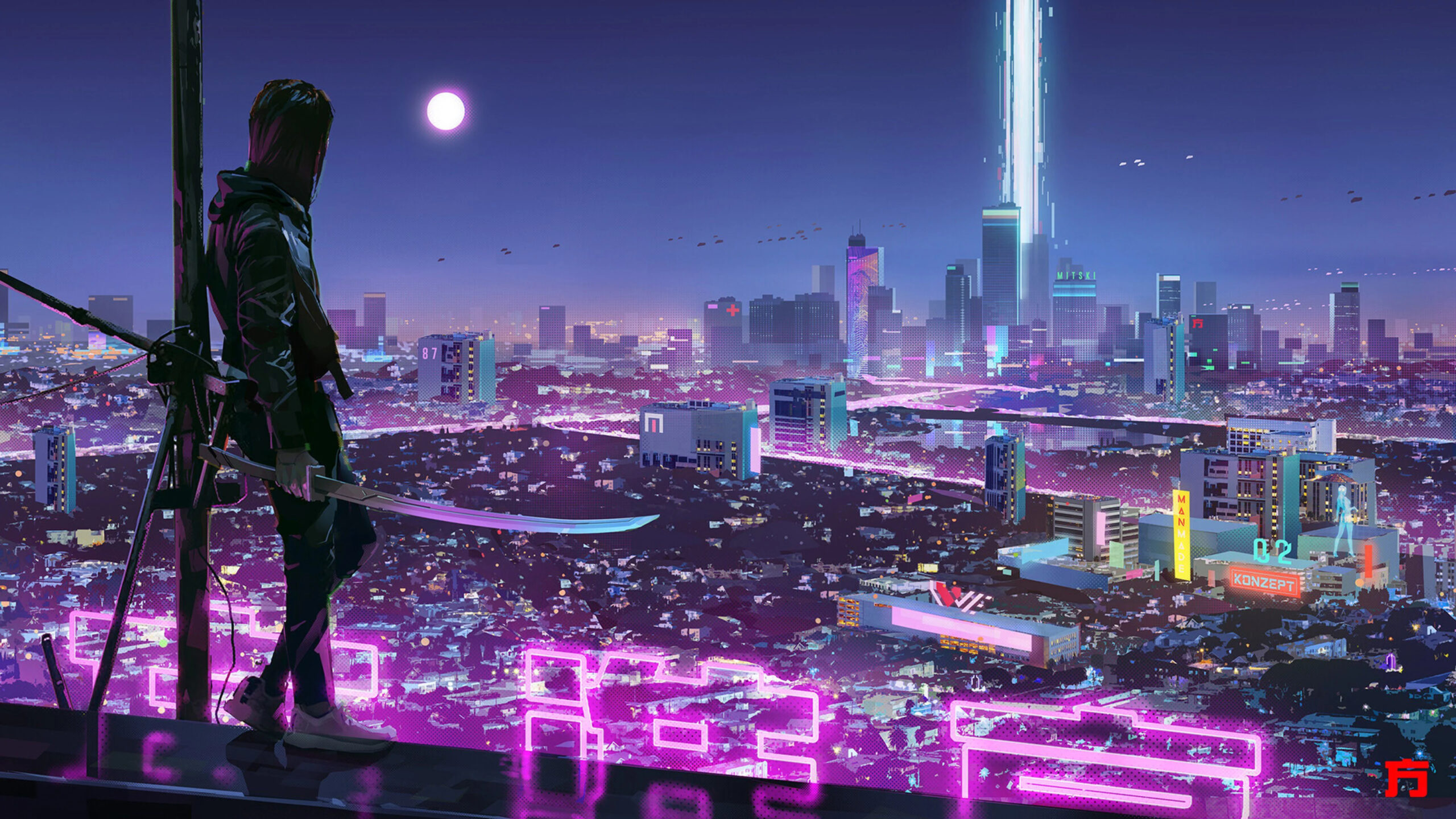
In recent episodes, we’ve seen how on-demand formats and more prestigious series often bring us back to the narrative point. Keanu Reeves has been mentioned several times on this date of ours and seems to have no intention of hiding his interest in Cyber worlds.
The actor has in fact repeatedly expressed his desire to reprise the role of Johnny Silverhand in the future of Cyberpunk 2077, a title that encompasses video games, books and Netflix series. His characters, along with lesser-known gems from the nineties, will accompany us today, drawing a red thread that unites Johnny Mnemonic (1995), Ghost in the Shell (1995) and Nirvana (1997), up to the most recent works such as Cyberpunk 2077 (2020) and Cyberpunk: Edgerunners (2022-2025).
Connecting these works we find the fundamental idea that technology is no longer a tool external to man, but a direct extension of it. In the years ’90 this view was perceived as extreme, almost disturbing. Today, in light of experimental neural chips, automated prosthetics, connected medical devices, and self-driving vehicles, it appears less science fiction than one would like to admit, while retaining its distressing features.
Night City and Man as a Vulnerable Endpoint
Cyberpunk 2077 catapults us to Night City, a megalopolis dominated by megacorporations, invasive cybernetic prosthetics, and vicious technological inequality. The protagonist, V, is a digital mercenary who thrives on intrusions, data theft, sabotage, and system manipulation. Hacking here is not a simple metaphor: it is an integral part of survival.
From quickhacks crashing a neural implant to breaking corporate networks, the game represents a world where every human is also an endpoint, constantly exposed. In the real world, we’re not at that level of mass neural grafts yet, but the concept is surprisingly current. Smartphones, wearables, personal clouds and IoT devices are already part of our digital identity today.
Compromising these devices is, in fact, equivalent to compromising the person. In this sense, Night City is an extreme –but not unrealistic– version of a society where the attack surface increasingly coincides with the human body.
Edgerunners: The Human Cost of Technology
The animated series Cyberpunk: Edgerunners reinforces this vision, shifting the focus from action to the human cost of technology. David Martinez is not a hacker in the classic sense, but becomes progressively an unstable platform, overloaded with cyberware. The central theme is not so much intrusion into systems, but the lack of security by design.
We see implants not designed for mental health, software that has no limits, and updates that are absent or imposed by corporations. The real parallel is disturbing: algorithms that push overworking, platforms that monetize attention, and systems that don’t protect the user but consume them.
In Edgerunners, “cyberpsychosis” is a narrative pathology, but in the real world it takes the form of digital burnout, technological dependence and loss of cognitive control. This is not active hacking, but a tacit violation of the individual.
Ghost in the Shell and Nirvana: Hacking Philosophies
Ghost in the Shell takes the discourse to an even more philosophical and, paradoxically, more concrete level. Major Motoko Kusanagi lives in a world where the boundary between mind and network is dissolved. The “ghost” is consciousness, the “shell” the artificial body. Here, the most dangerous hacking is not stealing data, but rewriting identities, manipulating memories, and altering the perception of reality.
In the film and series, attacks occur directly on the mind through intrusions into cyberbrains. Although it is science fiction, the concept is at the center of the neurosecurity debate today: if brain-machine interfaces become common tomorrow, who will ensure the integrity of thoughts? Already today we are witnessing primitive forms of this phenomenon with deepfakes, algorithmic disinformation and psychometric profiling.
Salvatores’s often underrated Nirvana is perhaps the most lucid work in a European key. Set in a dirty near future, it tells the story of a programmer who tries to erase a video game character who has become self-aware. Cyberspace here is not glamorous, but degraded, unstable, and profoundly human.
Hacking in Nirvana involves abusive access, code manipulation, and the exploitation of logical flaws. It’s a “handcrafted” hack, much closer to reality than it seems. We don’t see omnipotent megacorporations, but fragile systems, poorly written and worse maintained. A world where security is an appendage, not a requirement, mirroring those working today with legacy systems and makeshift infrastructure.
Information control and real parallels
In classic cyberpunk, the plot almost always revolves around controlling information. Johnny is a data carrier because data is too dangerous to stay on a traditional medium. If we analyze Ghost in the Shell, the information coincides with identity itself: hacking a “ghost” means rewriting a person.
Nirvana’s approach, on the other hand, shows us how code generates consciousness and bugs become a form of digital suffering. Finally, in Cyberpunk 2077 and Edgerunners, information is pure power: those who control data, firmware, and networks control the city, bodies, and lives. This narrative pattern reflects the real world surprisingly accurately.
There are no illegal neural couriers like Johnny today, but there are poorly configured clouds, unsecured endpoints, compromised software supply chains, and personal devices that contain more sensitive data than any server in the ’90s. Smartphones, wearable devices, medical implants and connected vehicles are, to all intents and purposes, digital extensions of the individual. And as such, they extend the attachment surface.
From Fiction to Reality: The Risks of Lack of Safety
The hacking techniques shown in these works, although fictionalized, are often based on real concepts. In Ghost in the Shell, “ghost hacking” is an extreme but conceptually correct representation of an identity takeover attack. Today, this results in compromised accounts, deepfakes, advanced social engineering, and digital identity theft. You don’t have to rewrite a brain, you just have to convince a person to trust the wrong message.
Similarly, in Nirvana, the key element is the unexpected bug that spawns a standalone entity. It’s a very modern metaphor for ungoverned software: approximate code, out-of-date libraries, and vulnerable dependencies. In the real world, major incidents often arise from design errors and poor software lifecycle control, rather than sophisticated attacks.
Cyberpunk 2077 and Edgerunners take a step further by bringing hacking to the physical plane: compromised cyberware, implant overrides, and prosthetic sabotage. We’re in pure science fiction, but the parallel is direct with the real risks associated with connected medical devices. Pacemakers, insulin pumps, and exoskeletons are already potential attack surfaces today, threatened not by criminal netrunners, but by a lack of security by design.
Conclusions: The human factor remains critical
Even the topic of ubiquitous megacorporations is not that far from reality. Today, few large platforms manage clouds, digital identities, and entire technology supply chains. An upstream configuration error or compromise can have systemic impacts, just like in cyberpunk narrative worlds.
Productions in the ’90s approached these themes with a tone of alarm. Contemporary ones, especially Netflix productions, integrate them as progressive facts. At Edgerunners, the problem is no longer whether to implant technology, but how much can be sustained before losing oneself. It is a paradigm shift that reflects the present: technology is no longer optional, but structural. Security, however, continues to be treated as a later addition.
Cyberpunk, therefore, does not predict the future: it describes the present using extreme metaphors. Looking at these works today means observing a long cultural continuity: the man who integrates the machine, without ever truly integrating its safety. The 2025 data confirms this lesson, with a 94% increase in attacks based on the fragility of the human factor. With the hope that the adventures of Keanu & co. will help us develop greater sensitivity on the subject, we wish you a Happy Vision!
Articolo in collaborazione con Lorenzo Raimondo, Managing Director di Observere